
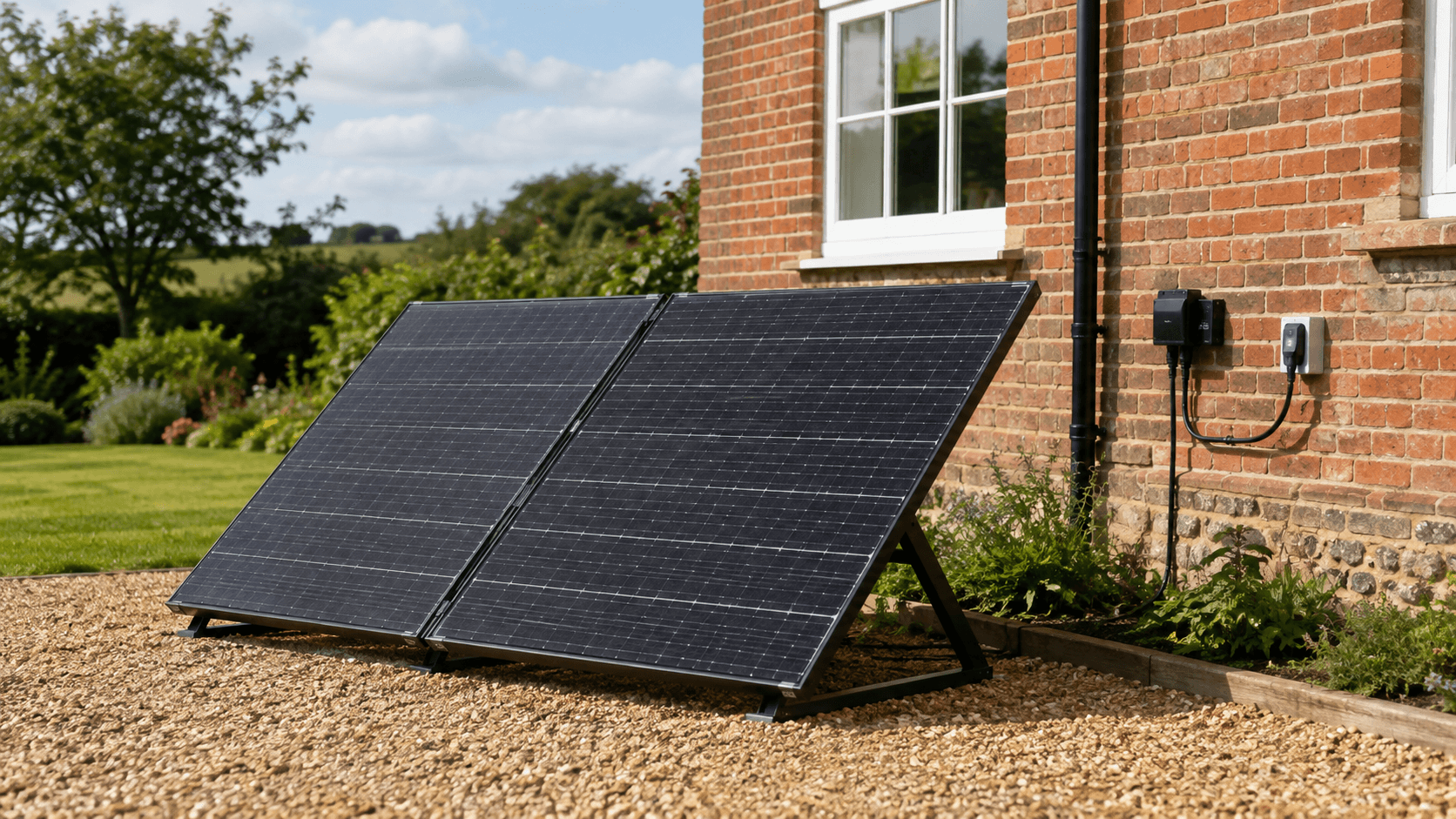
Plug-In Solar Panels Are Now Legal: What Norfolk Homes Need to Know




Plug-in solar panels are now legal to buy and use in Norfolk, provided the system complies with the new UK rules and has a maximum output of 800W. These compact systems give households a lower-cost way to generate electricity, but their suitability depends on the product, installation location, available sunlight and condition of the property’s electrical system. This guide explains how plug-in solar panels work, their potential savings and how they compare with professionally installed rooftop solar.
What Are Plug-In Solar Panels?
Plug-in solar panels are small photovoltaic systems designed to feed generated electricity into a home through a compatible socket. A typical kit includes one or more solar panels, a mounting system, cabling and a microinverter.
The panels generate direct current electricity when exposed to daylight. The microinverter converts this electricity into alternating current, which can then be used by appliances operating in the home. Electricity generated and consumed at the same time reduces the amount drawn from the grid.
Unlike a conventional rooftop system, a compliant plug-in kit is designed for straightforward consumer setup and does not require a solar installer to connect a dedicated circuit. The product must still meet the new UK safety specification and be used according to the manufacturer’s instructions.
Are Plug-In Solar Panels Legal in the UK?
Yes. Plug-in solar panels became legal to buy and use in England, Scotland and Wales on 27 August 2026. The regulatory change allows one compliant plug-in solar array with a maximum generation capacity of 800W per household.
The UK Government’s plug-in solar announcement states that compliant systems underwent independent safety testing covering their key electrical components and compatibility with UK wiring. Households should still check that a product appears on the approved device list before purchasing it.
The change does not currently cover plug-in battery storage. Batteries connected to a solar installation remain subject to separate product, design and electrical-safety requirements.
How Much Electricity Can an 800W Solar Kit Generate?
An 800W rating describes the kit’s maximum output under suitable test conditions. Actual generation will change throughout the day and year according to:
- Panel direction and angle
- Shading from trees, fences and buildings
- Seasonal daylight levels
- Local weather
- Panel temperature and condition
- Microinverter efficiency
The government estimates that an 800W system could provide up to 20% of an average home’s electricity use and reduce annual bills by as much as £110. These figures are not guaranteed. A shaded or poorly positioned kit may generate substantially less, while a well-positioned system paired with daytime electricity use may deliver better value.
The greatest benefit comes when the household uses the generated electricity as it is produced. Fridges, routers, home-office equipment and other daytime loads can consume that power before electricity needs to be imported from the grid.
Are Plug-In Solar Panels Suitable for Norfolk Homes?
Plug-in solar could suit Norfolk households that have an unshaded garden, terrace or other permitted outdoor space but cannot justify or accommodate a rooftop system. The option may be particularly relevant to tenants and flat owners, although permission may still be required.
Before purchasing a kit, consider:
- The amount of direct daylight available
- The stability and security of the proposed mounting position
- Access to the connection point specified by the manufacturer
- Shading at different times of day and across the year
- Permission from a landlord, freeholder or building owner
- Planning or listed-building restrictions
- The age and condition of the property’s electrical installation
The Energy Saving Trust’s solar guidance notes that the first products available in the UK may be better suited to garden locations than balconies. Buyers should assess the actual product requirements rather than assume every kit is suitable for every balcony or property.
Do You Need an Electrician to Install Plug-In Solar Panels?
A compliant plug-in solar kit is designed so that a qualified electrician is not required for the basic setup. That is one of the main differences between these systems and professionally installed rooftop solar.
An electrical inspection may still be sensible when:
- The property has old or visibly damaged wiring
- The intended socket is loose, cracked or affected by heat marks
- Circuit breakers or RCDs trip regularly
- The consumer unit is outdated or has known defects
- The proposed connection point is unsuitable for outdoor equipment
- The homeowner is uncertain about the condition of the circuit
The plug-in product approval does not correct faults already present in a home’s fixed wiring. Norfolk properties with ageing electrical installations may benefit from having the connection point and circuit assessed before new generating equipment is used.
If the consumer unit is outdated or unable to provide appropriate protection, Electric11 can assess the installation and explain if a replacement consumer unit in Norfolk is recommended. A replacement should be based on the condition of the installation, not treated as an automatic requirement for every plug-in kit.
Plug-In Solar vs Rooftop Solar Panels
Plug-in and rooftop systems serve different household needs. The lower upfront cost and simpler setup of an 800W kit make small-scale generation accessible, while a designed rooftop system can produce substantially more electricity and support wider home-energy goals.
| Feature | Plug-in solar kit | Rooftop solar PV system |
|---|---|---|
| Typical capacity | Up to 800W under the new rules | Designed around the roof, supply and household demand |
| Installation | Consumer setup for approved kits | Professionally designed and installed |
| Generation potential | Limited small-scale output | Higher annual generation |
| Battery integration | Plug-in batteries are not included in the new rules | Battery storage can be designed into the installation |
| Export options | Check product and tariff requirements | MCS documentation may support Smart Export Guarantee applications |
| Best suited to | Renters or homes without a practical rooftop option | Homeowners seeking larger, long-term savings |
For homeowners who want to cover a greater share of their electricity use, charge an EV from solar or add battery storage, a professionally designed system will normally be more appropriate. Electric11 provides solar panel installation across Norfolk, with the system designed around roof space, shading, electricity demand and future energy plans.
Can You Add Battery Storage to Plug-In Solar?
Plug-in battery products are not included in the August 2026 regulatory change. Consumers should not assume that a battery advertised online can be connected safely or legally to an approved plug-in solar kit.
A professionally designed battery system works differently. It can store surplus electricity from a rooftop array for use later in the day, subject to the system design, battery capacity and household demand. Homes considering a larger renewable-energy setup can review Electric11’s home battery storage options in Norfolk alongside a full solar assessment.
What Should You Check Before Buying a Plug-In Solar Kit?
Use this checklist before ordering:
- Confirm that the device is approved for use under the UK specification.
- Check that its maximum output does not exceed the permitted 800W limit.
- Read the manufacturer’s mounting and connection instructions.
- Confirm that the proposed location receives useful daylight.
- Check the rules for rented, leasehold, listed or conservation-area properties.
- Inspect the intended socket for visible damage or deterioration.
- Review the warranty, monitoring features and expected service life.
- Compare the expected generation with the household’s daytime consumption.
- Confirm who is responsible for any required registration or notification.
- Compare the long-term return with a professionally installed rooftop system.
Price alone should not determine the purchase. Product approval, suitable positioning, realistic generation estimates and the condition of the existing electrical installation all affect the result.
What Maintenance Do Plug-In Solar Panels Need?
Maintenance requirements will depend on the product and mounting position. Owners should keep the panels free from significant debris, check for visible cable or connector damage and monitor generation for unexpected changes. Any inspection or cleaning should follow the manufacturer’s instructions.
A sudden reduction in output is not always caused by dirt. Shading, equipment faults, damaged cabling and connection problems can also affect generation. Electric11 provides solar panel maintenance across Norfolk for conventional solar PV systems, including inverter testing, performance checks, cabling assessments and electrical-safety inspections.
Owners of plug-in kits should first consult the product manufacturer or retailer about faults, warranty claims and product-specific servicing.
Are Plug-In Solar Panels Worth It?
Plug-in solar panels may be worthwhile for households that have a suitable sunny location, use electricity during daylight hours and cannot install a larger rooftop array. Their lower entry cost makes small-scale solar generation available to a broader range of households.
They are less suitable for people expecting to power most of their home, charge an EV primarily from solar or store large amounts of surplus generation. Those goals normally require a larger system designed around the property and its electricity demand.
The right comparison is not simply “cheap solar versus expensive solar”. It is the amount of usable electricity each option is likely to generate, the household’s future plans and the expected return over the product’s lifespan.
Solar Advice for Norfolk Homeowners
The arrival of plug-in solar gives Norfolk households another way to reduce grid electricity use, particularly where rooftop installation is not practical. A compliant 800W kit can be a useful small-scale option, but buyers should check product approval, permissions, positioning and the condition of the intended connection point.
For households seeking higher generation, battery integration or a system designed around long-term energy use, Electric11 can assess the property and recommend an appropriate solar PV solution. Contact Electric11 to discuss solar installation, system maintenance or an electrical inspection anywhere across Norfolk.
Frequently Asked Questions
When did plug-in solar panels become legal in the UK?
Compliant plug-in solar panels became legal to buy and use in England, Scotland and Wales on 27 August 2026. The change does not currently extend to Northern Ireland.
What is the maximum size of a plug-in solar system?
The new rules permit one compliant plug-in solar array with a maximum output of 800W per household.
Can renters install plug-in solar panels?
Renters may be able to use an approved kit, but they should check their tenancy agreement and obtain any required permission from the landlord, freeholder or building owner before installation.
Can an 800W solar kit power an entire home?
No. An 800W kit is intended to offset a portion of household electricity use. Its actual contribution depends on sunlight, panel position and how much electricity the home consumes while the panels are generating.
Do plug-in solar panels work on cloudy days?
Solar panels can still produce electricity in cloudy conditions, but their output will normally be lower than during strong, direct sunlight.
Can I connect a plug-in battery to the system?
Plug-in battery storage is not included in the August 2026 regulatory change. Battery storage should be selected and installed according to the applicable product and electrical requirements.
Send us a message
"*" indicates required fields

