
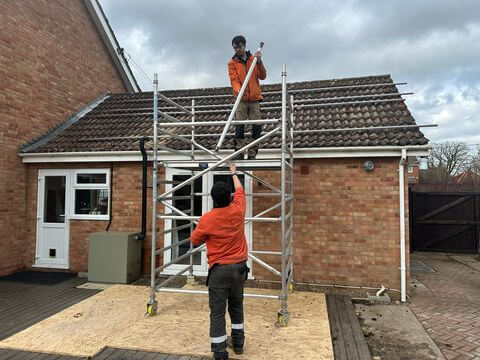




When you start comparing solar quotes, your attention naturally goes to the panels, inverter and battery. Then scaffolding appears on the estimate, raising another set of questions: is it necessary, how much should it cost, and who organises it?
Scaffolding for solar panels is an important part of planning safe access to many domestic roofs. It provides access and edge protection while installers carry out the rooftop work. The arrangement depends on your property, the proposed panel layout and the installation method.
For homeowners in Norfolk, those details can vary considerably. A bungalow with an accessible driveway presents different challenges from a terraced house beside a pavement or a roof above a conservatory.
This guide explains what to ask before accepting a quote, how to understand access costs, and how to prepare your home without overlooking the practical details.
Do You Need Scaffolding for Solar Panels?
For a typical installation on a pitched house roof, you should expect scaffolding and suitable edge protection to form part of the access plan.
The Health and Safety Executive’s guidance on roof work explains that roof work must be planned safely and identifies scaffolding and edge protection as key precautions for sloping roofs. Its limited allowance for certain tasks lasting only minutes should not be treated as a general exemption for solar installations.
However, not every solar project needs the same arrangement. Ground-mounted panels, accessible flat roofs and other building layouts require their own assessment.
The useful question is therefore: “What safe access arrangement does my installation require?”
Why a ladder is not a complete access plan
Getting someone onto a roof is only one part of the job. Installers also need to reach the working area, position equipment and complete the installation without leaving people exposed to falls.
A proposal that simply says “ladder access” needs more explanation. Ask how the contractor will manage the actual roof work, protect roof edges and move materials.
You do not need to design the solution yourself. You should receive a clear explanation from the people responsible for carrying out the work.
Does a bungalow still need scaffolding?
A lower roof does not automatically remove the need for protection. Roof pitch, working position, surrounding ground and obstacles all matter.
For example, a bungalow with a conservatory below the intended array may require a more involved arrangement than a taller property with unobstructed access. Building height alone is not a reliable guide to cost or equipment choice.
How Much Does Scaffolding for Solar Panels Cost?
There is no single price that applies to every home.
As one published market reference, Checkatrade’s solar installation offering states that scaffolding typically costs around £500–£750 for the installations described on that page. This is an indicative example from that offering, not a nationwide fixed price or an Electric11 quotation.
Your property may need a different allowance, particularly where access is restricted or panels are planned across several roof slopes.
A useful solar panel scaffolding cost should come with a clear scope. A lower figure is not necessarily better value if it excludes dismantling, access over an extension or the hire period your project needs.
What changes the price?
| Factor | Why it matters |
| Height and roof-edge length | The scaffold must reach the relevant working areas. |
| Number of roof slopes | Panels on separate elevations may require additional access. |
| Conservatories and extensions | Obstructions can complicate the scaffold arrangement. |
| Ground conditions | Sloping ground, restricted space and supporting surfaces need assessment. |
| Access for delivery | Narrow passages or limited unloading space can affect the work involved. |
| Hire period | Delays or additional work may extend the agreed period. |
| Public pavement or road involvement | Licensing and public-access arrangements may be required. |
| Changes after booking | Altering the panel layout or work scope may require scaffold changes. |
Use these factors to ask better questions rather than trying to calculate a price from panel count alone.
Is scaffolding included in the solar quote?
It may be included in the installation total, listed separately or excluded from an initial estimate. Ask for written confirmation.
Before accepting the quote, check:
- Does the price cover erection and dismantling?
- Which roof slopes and working areas are included?
- What hire period is allowed?
- Who pays if the installation is delayed?
- Are any access restrictions or specialist arrangements excluded?
- Are applicable taxes and licence charges clearly addressed?
An itemised quote makes it easier to compare installers offering different packages.
For advice on the wider project, Electric11’s solar panel installation in Norfolk page explains its local installation service and the factors considered when planning a system.
Who Arranges the Scaffolding?
The arrangement depends on your installer and contract. The solar contractor may coordinate a scaffolding company, or you may be asked to organise access separately.
What matters is that the installer approves the proposed arrangement before it is booked.
Booking independently without that agreement can create problems. The scaffold might cover the wrong elevation, obstruct the intended panel position or fail to provide the access the installation team needs.
Ask for one named contact who can confirm:
- Who specifies the access requirements.
- Who books the scaffolder.
- Who checks that the scaffold is suitable before work starts.
- Who handles schedule changes.
- Who authorises dismantling.
Agreeing these responsibilities early helps prevent a situation where the scaffold is ready but the installers cannot use it.
Can you use scaffolding already installed for roof repairs?
Possibly, but it must be assessed for the solar work.
Scaffolding provided for gutter repairs, painting or roofing is not automatically suitable for installing panels. The working areas, access and intended loads may differ.
Tell both contractors about the proposed shared use before either job begins. The scaffold provider and solar installer should agree whether alterations are necessary and how the hire period will be managed.
Coordinating projects can avoid paying for two separate visits, but any saving depends on the existing structure being suitable and the schedules lining up.
What Safety Requirements Should Be Covered?
Homeowners should expect the access plan to address the work being undertaken, rather than being offered the same arrangement for every roof.
HSE’s scaffolding guidance states that scaffolds must be designed, erected, altered and dismantled by competent people. It also explains that the arrangement must suit the work and expected loads; structures outside recognised standard configurations may require a specific design.
For your project, ask the contractor to explain how they will address:
- Access to the working area.
- Protection at exposed roof edges.
- The condition of the roof and any fragile areas.
- Movement of panels and installation materials.
- Protection for people using the property below.
You should not remove boards, move guardrails or alter the scaffold to make room for a vehicle or delivery. Contact the scaffold provider if something needs changing.
Who checks the scaffold?
Inspection arrangements should be clear before the installation starts.
GOV.UK’s scaffolding rules explain that safety checks are required before first use, every seven days while the scaffold is up, and after alterations, damage or extreme weather.
Ask who is responsible for those checks and whom to contact if you notice damage. A homeowner’s visual check is not a substitute for the required competent inspection.
Do You Need Permission for Scaffolding?
Where scaffolding is positioned can affect the permissions required.
A scaffold wholly within your property boundary raises different questions from one occupying the pavement outside a terraced house.
Under the government guidance on scaffolding licences, scaffolding on a public highway requires a licence from the relevant local authority. Public highway space can include the pavement.
The builder or scaffolding company should arrange the necessary highway licence. GOV.UK also advises homeowners to check that the licence exists and remains valid for the work.
If access requires use of a neighbour’s land, raise this before installation dates are agreed. Do not assume permission is included in your solar quotation.
Planning requirements for the solar panels themselves are a separate matter. A scaffold licence does not settle any planning or listed-building questions about the installation.
How Long Will the Scaffolding Stay Up?
The scaffold hire period and the time spent fitting panels are not necessarily the same.
A scaffold may need to be erected before the installation team arrives and collected after the rooftop work has been checked. Delivery schedules, weather and any additional roof work can affect the dates.
Instead of relying on a general promise such as “only a few days”, ask for an expected sequence:
| Stage | What to confirm |
| Before erection | Access arrangements, working areas and preparation tasks |
| Scaffold installation | Expected arrival date and who confirms readiness |
| Solar installation | Planned work dates and arrangements if weather intervenes |
| Completion checks | Whether any further rooftop access is needed |
| Dismantling | Who books collection and the expected removal window |
This is especially useful if the scaffold will affect parking, garden access or a shared passage.
Discuss any important dates before booking. For example, tell the contractor if you have a delivery, building work or an event planned at the property.
What If Your Roof Is Above a Conservatory or Extension?
A conservatory, lean-to or lower roof can change both the access method and the cost.
These structures may prevent a straightforward scaffold arrangement beside the main wall. The contractor must assess how to reach the roof without relying on unsuitable supporting surfaces.
Send photographs of these obstacles when requesting a quote, but expect the contractor to decide whether a site visit or further information is needed.
Useful photographs include:
- The full elevation where panels are proposed.
- The conservatory or extension below it.
- Side passages and gates.
- The driveway or proposed unloading area.
- Any obvious changes in ground level.
For a home in Wymondham with panels planned above a rear conservatory, the rear elevation may be the main access challenge. For a village property near Attleborough, restricted side access might be the more important issue. These are illustrative situations, not fixed pricing categories.
The aim is to identify obstacles before the scaffold team arrives.
How Can You Control Costs Without Reducing Safety?
The best opportunities usually come from clear planning and avoiding repeat work.
Finalise the panel layout before booking access
Ask whether the proposed array is confirmed. Moving panels onto another roof slope after the scaffold has been erected may change the access requirement.
If you are comparing different system layouts, consider the complete installed price, including access, rather than panel prices alone.
Discuss roof condition early
If your roof needs attention, discuss that before scheduling solar installation.
It can be more practical to coordinate roof repairs and solar work than to discover a problem once access is already in place. Ask the relevant contractors to agree the order of work and responsibility for any changes.
Coordinate related work carefully
If you are already arranging roof or gutter work, tell your solar installer. Shared access may be worth investigating.
However, do not extend the scaffold hire simply to fit in unrelated tasks without comparing the additional cost. A longer hire period or alterations could reduce the expected saving.
Compare the same scope
A useful comparison includes the same access areas, hire period, dismantling arrangements and exclusions.
Ask each provider to explain differences. That is more informative than choosing the lowest line item without knowing what it includes.
Preparing Your Norfolk Home for Installation
Before the scaffold arrives, request a short preparation checklist from your installer.
Depending on the agreed plan, this may involve moving cars, clearing garden furniture, unlocking side gates or making space for unloading. Confirm arrangements for pets and children, and identify any entrances that must remain accessible.
Tell the team about:
- Shared driveways or access routes.
- Restricted delivery times.
- Delicate paving or landscaped areas.
- Regular access needed by household members.
- Other trades working at the property.
Electric11 serves Norfolk locations including Attleborough, Wymondham, Dereham, Thetford and Diss. Its local service-area information can help you check coverage before discussing a project.
Will You Need Scaffolding Again for Maintenance?
Not every solar-related fault requires roof access. Some investigations involve monitoring, the inverter, battery equipment or accessible electrical components.
Work on the panels, roof fixings or rooftop wiring may need a new access assessment. Do not assume that the original scaffold arrangement will always be necessary, or that future roof work can be completed without it.
When comparing installation proposals, ask how future maintenance access would be handled. It is also worth clarifying whether any warranty or service agreement covers access costs.
If an existing system needs attention, Electric11 offers solar panel maintenance in Norfolk. Explain the issue first so the appropriate investigation can be planned.
Frequently Asked Questions
Is scaffolding for solar panels legally required on every property?
There is no single scaffold arrangement that applies to every solar project. Work at height must be planned safely, and HSE identifies scaffolding and edge protection for sloping-roof work. A ground-mounted array or a different roof-access situation needs its own assessment. Ask your installer to explain the proposed method for your property.
How much should I budget for solar panel scaffolding?
A published Checkatrade solar installation offering gives an indicative figure of around £500–£750, but that is not a universal price. Your cost depends on the building, access restrictions, roof slopes and agreed hire period. Request a property-specific quotation that clearly explains what is included and what could cost extra.
Is scaffolding included in the price of solar panels?
That depends on the quotation. Some installation packages include access, while others list it separately or add it after a survey. Ask for written confirmation covering erection, hire, dismantling and any specialist arrangements. Check the exclusions before comparing the total price with another installer’s offer.
Can solar installers use my roofer’s scaffolding?
They may be able to, provided it is suitable for the solar work and its use is agreed. Ask the solar installer and scaffold provider to review the arrangement before scheduling installation. Any necessary alterations, inspections and hire extensions should be confirmed so responsibilities and costs are clear.
Can solar panels be installed without scaffolding on a bungalow?
A bungalow’s lower height does not automatically make scaffold-free installation appropriate. The contractor must consider the roof pitch, working area, access and fall risks. Ask for the proposed safe working method rather than assuming that a ladder will be sufficient because the property has only one storey.
What happens if bad weather delays the installation?
The installer should decide whether conditions allow the work to proceed safely. Before booking, ask how weather delays affect installation dates, scaffold hire and removal. Also clarify who pays for any extension. Having these terms in writing helps avoid uncertainty if the roof work must be rescheduled.
Plan Your Solar Installation With Electric11
Understanding scaffolding for solar panels helps you compare quotes and prepare your property with fewer surprises. Before committing, make sure the access method, total cost, responsibilities and removal arrangements are clear.
If you are planning solar for a Norfolk home or business, explore Electric11’s solar panel installation service or contact Electric11 to discuss your roof, proposed system and access questions. You can also call 01953 661 155 to arrange the next step.
Send us a message
"*" indicates required fields

