
Do I Need a New Consumer Unit Before Installing an EV Charger?




Not necessarily. Whether you need a new consumer unit before installing an EV charger depends on your existing electrical installation, the charger selected and a professional assessment. Your electrician must check that the relevant equipment, supply and safety arrangements can support the addition. Sometimes the existing unit can remain; sometimes separate protection or replacement is appropriate. Age or appearance alone does not decide this. IET guidance on additions to existing installations explains the underlying checks.
Does every EV charger installation require a new consumer unit?
No. A consumer unit, often called a fuse board, distributes electricity to your home’s circuits and houses protective devices.
A typical home wallbox needs a dedicated electrical circuit, but that does not automatically mean replacing the board serving the rest of your home. The electrician must establish where the circuit can safely connect and which protective devices it needs. The IET’s EV protection guidance explains these requirements.
Equally, a spare slot is not proof that a charger can simply be added. The board’s loading and the suitability of its components also matter.
What will an electrician check?
An assessment should look beyond the fuse board itself.
The consumer unit and connections. Your electrician will assess condition, ratings, available space and suitability for sustained charging loads. New protective devices must be compatible with the board: physically fitting is insufficient. See the IET’s guidance on component compatibility.
The electricity supply and household demand. Electric showers, heating, cooking appliances and battery charging can affect how much capacity remains for a vehicle. A new consumer unit does not increase the capacity of the incoming electricity supply. UK Power Networks explains when supply upgrades may be necessary.
Earthing and bonding. These safety connections help protect against electric shock. Depending on the supply arrangement, the design may need protection against an “open PEN” fault—a break in a shared neutral and earth conductor in the electricity network that can make exposed metalwork dangerous. The IET explains this EV charging risk.
The charger, cable route and protection. An RCD detects certain electrical leakage faults and disconnects the supply. An RCBO combines residual-current protection with protection against overloads and short circuits. EV charging also requires consideration of direct-current leakage, which can affect protection devices. The correct arrangement depends on the equipment and installation.
Built-in charger protection does not automatically remove the need for external protection. For example, the myenergi zappi 2.1-T installation manual specifies an additional upstream Type A RCD or RCBO. Your installer must use the documentation for the exact model.
When might a replacement or another upgrade be needed?
Replacement may be appropriate where the existing consumer unit is damaged, unsuitable for the proposed loading, or unable to accommodate compatible protective devices. A wider electrical renovation may also make replacement the practical choice.
However, limited space can sometimes be addressed with a separate unit. The IET describes both replacement and separate EV consumer units as possible approaches.
Other work might involve earthing, bonding, cabling or the incoming supply. These are distinct issues: replacing the consumer unit will not, by itself, resolve every installation problem.
If replacement is recommended, ask which finding makes it necessary and whether another compliant option is available. Electric11’s consumer-unit replacement service in Norfolk starts with assessment of the existing installation.
What other compliant options might be available?
The appropriate solution depends on the survey and design.
| Possible approach | When it may suit the property | Important limitation |
|---|---|---|
| Retain the existing consumer unit | Its condition, loading and compatible protection allow the new circuit | Spare space alone is insufficient |
| Install a separate EV consumer unit | A dedicated arrangement can provide suitable protection without replacing the main board | Its supply, position and protection still need assessment |
| Replace the main consumer unit | The existing board cannot suitably support the proposed arrangement | Other electrical or supply work may still be needed |
Load management may also help where available supply capacity is limited. It monitors household demand and reduces charging power when necessary. Myenergi explains how its grid monitoring supports this function.
This can mean slower charging while other appliances are running. It does not replace essential circuit protection or repairs, and any network requirements still apply.
How do these findings affect the quote and installation?
Ask for a quote that identifies:
- The charger model, location and proposed cable route.
- The consumer-unit arrangement and protective equipment.
- Any necessary remedial work or load management.
- Any electricity-network work, approvals or dependencies.
- Testing, certification and Building Regulations notification.
For a Norfolk home with a detached garage, the route to the parking space may influence the work as much as the consumer unit. Discuss planned solar panels, battery storage or a second EV during the assessment.
UK Power Networks distinguishes installations that can proceed with subsequent notification from those needing supply work first. Your installer should establish the correct route before promising an installation date.
In England, installing a new circuit and replacing a consumer unit are notifiable work under Part P. Agree who handles notification and ask for the Electrical Installation Certificate and Building Regulations compliance documentation. These are separate records. Government guidance on electrical safety and Part P explains the framework.
What does Electric11’s Loddon project illustrate?
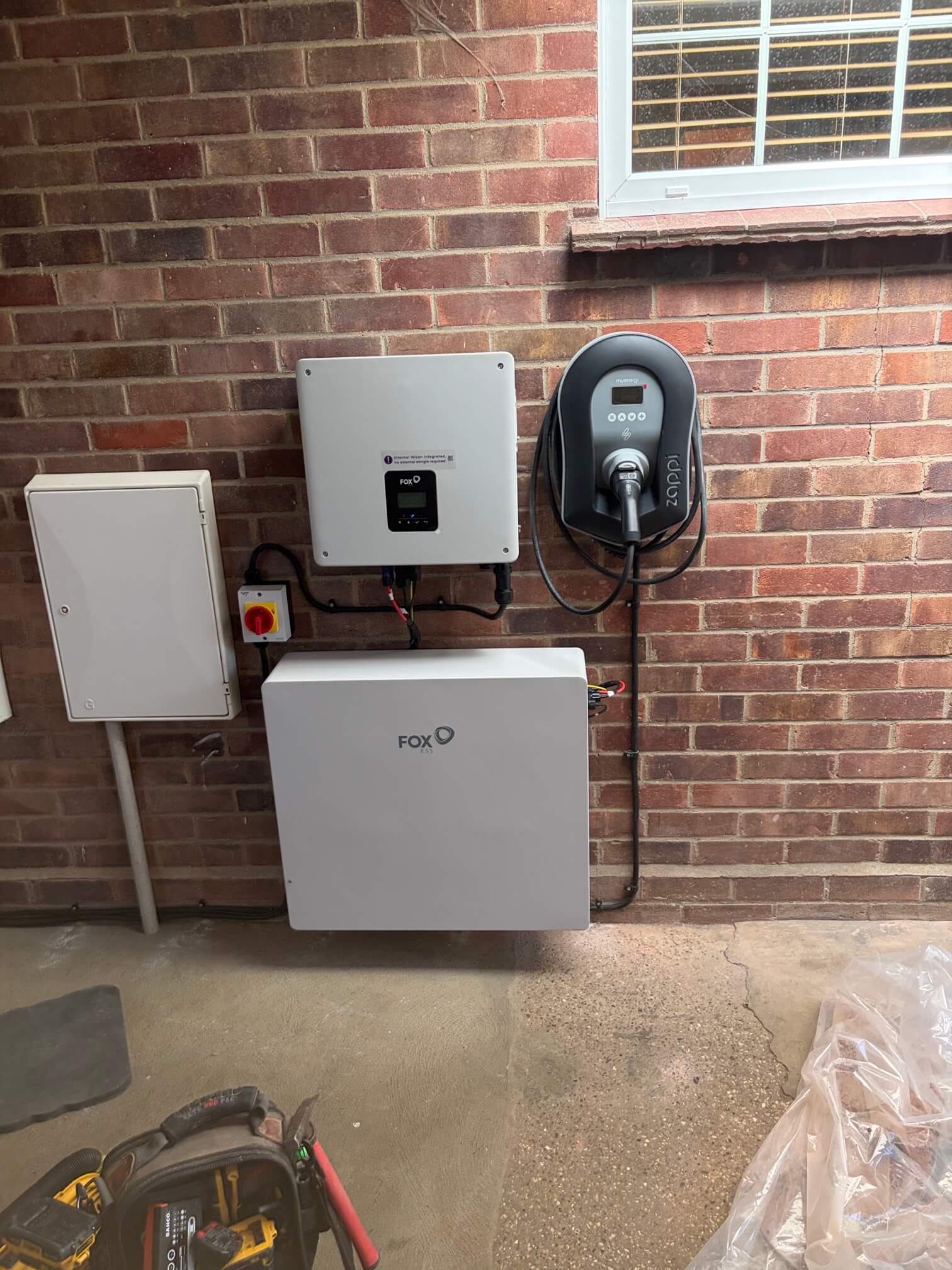
Electric11’s published battery storage and EV charger case study near Loddon records a Fox ESS battery system, a 5 kW inverter, a wall-mounted Zappi charger and replacement of the existing consumer unit with a double-stacked Elucian unit.
It illustrates how charging, storage and electrical distribution can be planned together. It does not establish that every Zappi installation needs a new consumer unit, or that the charger alone caused the replacement decision.
For another homeowner, the useful lesson is to discuss the whole proposed installation before agreeing the scope.
What else do homeowners ask?
Can you decide from photographs?
Photographs can help an initial discussion, but cannot establish electrical test results or reveal every connection. Keep covers in place; let the electrician determine what further inspection is needed.
Should I buy the charger before the assessment?
Ideally, confirm suitability first. Choosing the model affects the protection requirements, cable design and charging features available.
Does a previous satisfactory EICR settle the question?
No. An Electrical Installation Condition Report is useful background, but the proposed additional load and charger still need assessment.
Will the electricity need to be switched off?
Expect planned isolation for electrical connection work. Ask which supplies will be affected and how to prepare; the arrangement depends on the agreed work.
How can I arrange an EV charger assessment?
Have your postcode, parking location, preferred charger or vehicle details, and any existing electrical certificates ready. Mention planned heating, solar or battery upgrades so they can be considered together.
Arrange an EV charger installation assessment with Electric11 to find out whether your Norfolk home can retain its consumer unit and receive a quote based on the work it needs.
Send us a message
"*" indicates required fields

