
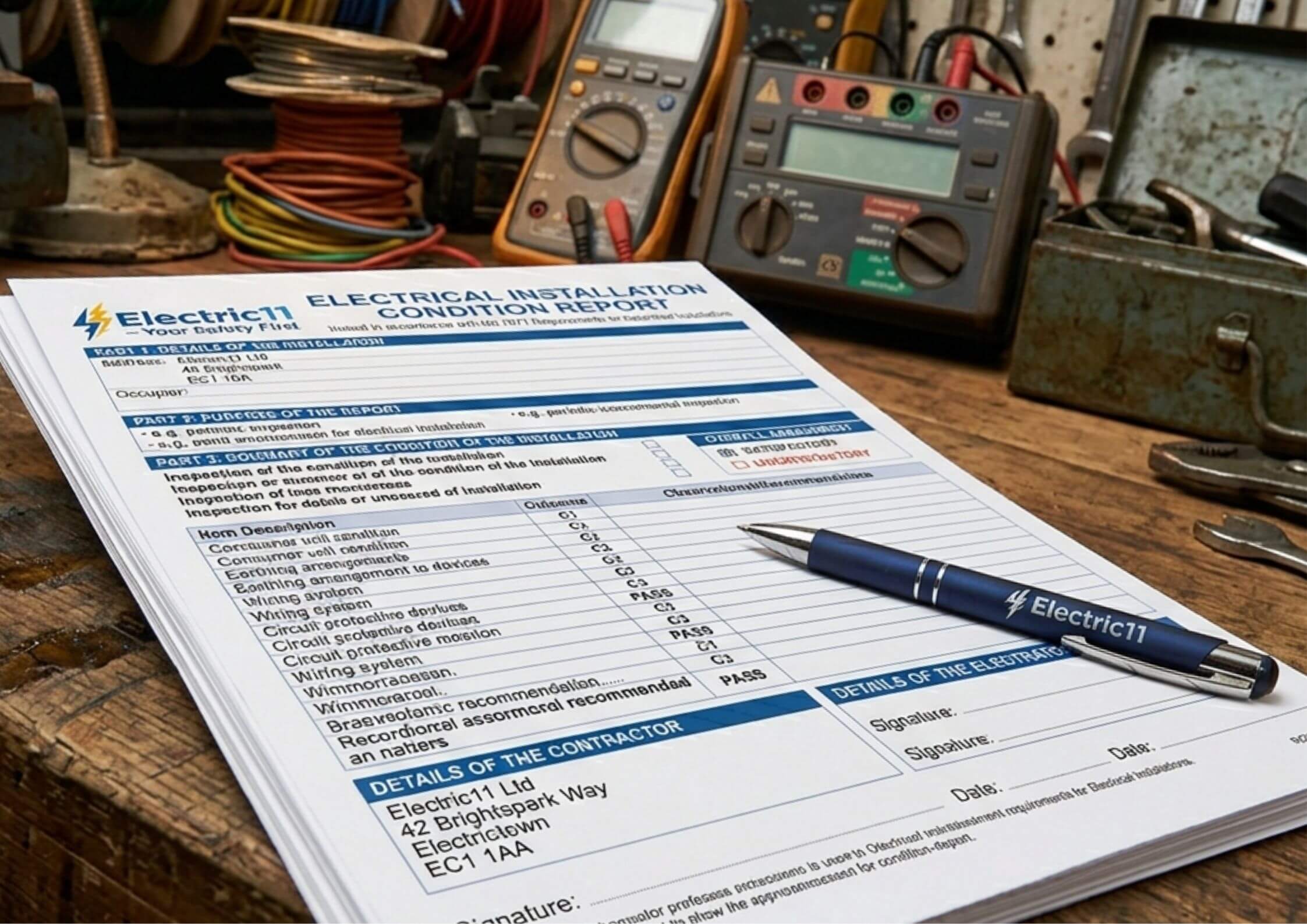




An EICR cost in Norfolk starts from £125 plus VAT for a one-bedroom flat with Electric11, with additional rooms charged from £25 plus VAT each. The final price depends on the number of circuits and consumer units, the size and condition of the installation, access, and the type of property.
This guide explains what you are paying for, what can increase the price and how to compare quotations fairly. If you already know you need an inspection, see our EICR certificate service in Norfolk or contact us for a property-specific quotation.

EICR prices in Norfolk at a glance
Electric11 publishes a simple starting price for domestic inspections. It gives customers a useful benchmark, but a final quotation may need more information about the electrical installation.
| Property or pricing item | Electric11 guide price |
|---|---|
| One-bedroom flat | From £125 + VAT |
| Each additional room | From £25 + VAT |
| Larger home, HMO or property with multiple consumer units | Quoted after reviewing the scope |
| Commercial property | Quoted according to circuits, boards, premises and access |
These figures cover the inspection and report at the agreed scope. They do not automatically include repairs, replacement parts, portable appliance testing or work needed to resolve an unsatisfactory result.
Headline EICR prices across the market vary widely. Some quotations cap the number of circuits, include only one consumer unit or add VAT later. Others include more testing and clearer reporting. A like-for-like comparison is more useful than choosing the lowest number on a website.
What is an EICR?
An Electrical Installation Condition Report, usually shortened to EICR, records the condition of a property’s fixed electrical installation at the time of inspection. It is not a pass certificate for every electrical item in the building.
The electrician inspects and tests parts of the fixed installation, which can include:
- The consumer unit and protective devices
- Final circuits serving sockets, lighting and fixed equipment
- Earthing and bonding arrangements
- RCD protection and disconnection times
- Signs of damage, overheating, deterioration or unsuitable alterations
- The results of electrical tests and any agreed limitations
The completed report includes observations, classification codes, an overall satisfactory or unsatisfactory outcome and a recommended date for the next inspection. Our plain-English guide to what an EICR certificate is explains the report in more detail.
Electrical Safety First’s periodic inspection guidance also explains that an EICR identifies damage, deterioration, defects and conditions that may present danger.
What affects the cost of an EICR?

Bedroom count is a convenient starting point, but it is not the best measure of the work involved. Two three-bedroom houses can have very different installations, circuit counts and access conditions.
Number of circuits
Circuit count is one of the strongest cost drivers. Every circuit within the agreed scope has to be considered, inspected and tested as appropriate. A compact home with electric heating, an EV charger, solar panels and several extensions may have more circuits than a larger property with a simple installation.
Ask if a quotation includes all circuits or applies a circuit limit. An unusually low headline price may rise once extra circuits are counted.
Consumer units and distribution boards
A property with one accessible consumer unit is normally simpler than a building with several boards, sub-boards or supplies to outbuildings. Each additional board can add circuits, test time and reporting work.
Tell the electrician about garages, garden rooms, workshops, annexes and converted lofts before accepting a quotation. This helps define the scope and reduces the chance of an unexpected adjustment on the day.
Property size and layout
More rooms usually mean more accessories, longer cable runs and more time moving around the property. Large detached homes, multi-storey houses, HMOs and mixed-use buildings may need a tailored quotation even when the basic room count looks straightforward.
Age and condition of the installation
Older wiring is not automatically unsafe, but ageing components, past DIY alterations, additions from different periods and signs of deterioration can make an inspection more involved. The electrician may need additional investigation to understand unusual readings or identify which circuits serve particular areas.
An older consumer unit does not fail solely because a newer design is available. Its condition, protection, compliance with the safety standard relevant to the assessment and the risks found during testing all matter. If replacement is recommended, Electric11 can quote separately for a replacement consumer unit in Norfolk.
Access and occupied rooms
Testing is quicker when the consumer unit, sockets and fixed equipment are accessible. Locked rooms, heavy furniture, stored belongings, tenant schedules and equipment that cannot be switched off can create limitations or require a return visit.
The report should record any agreed or unavoidable limitations. A quotation that assumes clear access may change if substantial parts of the installation cannot be reached.
Property use
A standard home, HMO, shop, office, workshop and industrial unit do not have identical testing needs. Commercial premises can have more circuits, three-phase supplies, specialist equipment and restricted working hours. Landlords with several properties may also need appointments coordinated around tenants.
Location and urgency
Travel, parking, restricted access and urgent turnaround can affect some quotations. Electric11 serves homes and businesses across its published Norfolk service areas, so provide the full postcode when asking for a price.
What should an EICR quotation include?
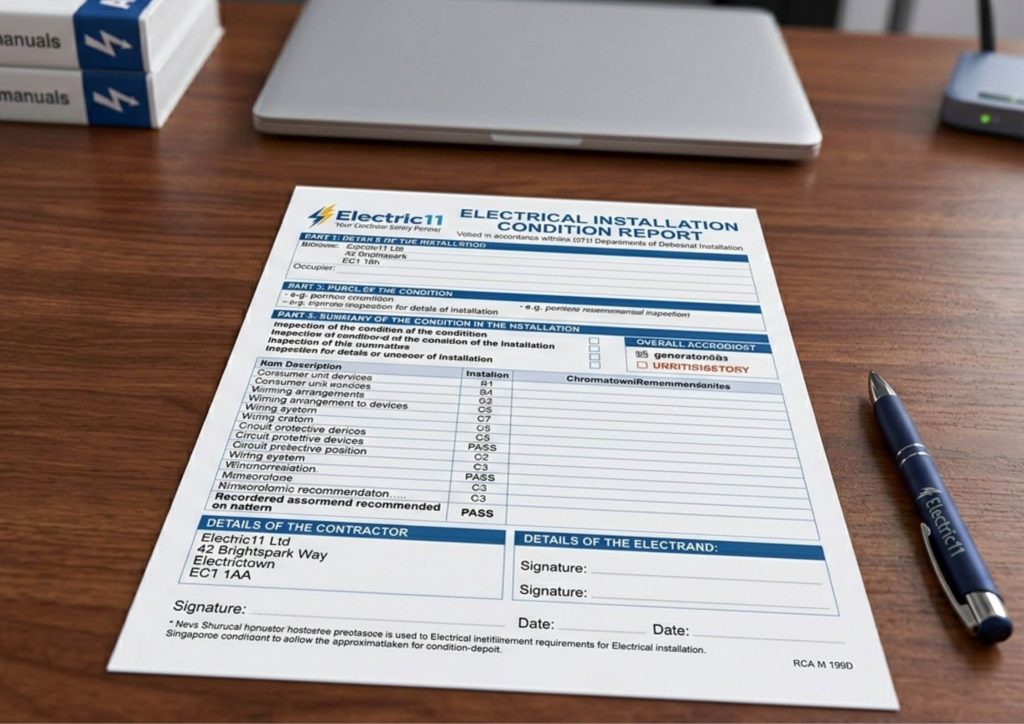
A good quotation makes the scope easy to understand before the appointment. It should state the property covered, likely number of consumer units, circuit allowance if one applies, VAT position and anything excluded.
The agreed price should normally cover:
- Inspection and testing of the fixed installation within the agreed scope
- Completion of the inspection and test schedules
- Classification of observed defects
- The EICR document and overall outcome
- A recommended interval to the next inspection
- Any stated report-delivery arrangement
Check if the quotation includes parking, travel, extra boards, outbuildings and a return visit. Also ask if the inspection price includes a minor repair allowance; many quotations do not, and it is often clearer to price remedial work after the report identifies exactly what is needed.
Electric11’s services and pricing overview provides further guidance on common electrical work.
What is not normally included in the EICR cost?
An EICR diagnoses and reports on the fixed installation. It is separate from the physical work required to correct a problem.
Common exclusions include:
- Remedial repairs and replacement components
- Rewiring or circuit alterations
- A new consumer unit
- Testing portable appliances
- Making good decorations after repair work
- Access to concealed wiring or areas outside the agreed scope
- A later visit to verify remedial work, unless stated
Portable appliances such as kettles, computers and plug-in equipment are outside the fixed-wiring report. Electric11 offers PAT testing as a separate service when it is needed.
How long does an EICR take?
Most domestic EICRs take several hours, but there is no reliable one-time-fits-all answer. A small, accessible flat with one consumer unit may be completed faster than a large occupied house with several boards, many circuits or faults requiring investigation.
Power to individual circuits needs to be interrupted during parts of the testing. Tell the electrician in advance about medical equipment, home working, alarms, servers, refrigeration or other loads that cannot be disconnected casually.
A very short appointment is not automatically better value. The electrician needs enough time to inspect, test, record results and report within the agreed scope. Ask what is included if one quotation promises a much faster inspection than the others.
What do EICR codes mean?
The classification codes communicate the urgency and nature of observations. They also help explain why a report may be unsatisfactory even when the lights and sockets appear to work normally.
| Code | Meaning | Typical next step |
| C1 | Danger present | Make safe immediately |
| C2 | Potentially dangerous | Arrange urgent remedial work |
| C3 | Improvement recommended | Consider improvement; it does not alone make the report unsatisfactory |
| FI | Further investigation required without delay | Investigate promptly and act on the finding |
A report containing a C1 or C2 observation is unsatisfactory. An FI observation also requires timely investigation and cannot simply be ignored in a rented property.
The price of remedial work depends on the defect, access and materials rather than the code alone. A loose connection may be inexpensive to correct, while damaged circuits or widespread unsuitable wiring can require substantial work. Electric11 provides electrical fault finding, and its Norwich EICR remedial-work case study shows how report findings can be resolved in practice.
If testing reveals that the installation needs extensive renewal, a home rewire in Norfolk should be scoped and quoted as a separate project.
EICR rules for landlords in England in 2026
Landlords need accurate, current information because some older cost guides repeat rules and penalty figures that have since changed. Norfolk properties are governed by the rules for England.
Under the current GOV.UK electrical safety standards guidance:
- The fixed electrical installation must be inspected and tested at least every five years, or sooner if the previous report requires it.
- A new tenant must receive a copy of the valid report before occupying the property.
- An existing tenant must receive a copy within 28 days of asking for it.
- The local authority must receive a copy within seven days of a written request.
- Required investigation or remedial work must be completed within 28 days, or sooner if the report specifies a shorter period.
- A fresh EICR is not automatically required at every tenancy change when the existing report remains valid and no required work is outstanding.
For relevant offences committed from 1 May 2026, a local authority can impose a financial penalty of up to £40,000. Earlier online articles often quote £30,000, which applied under the previous regime.
Landlords can read Electric11’s dedicated EICR guidance for landlords for practical planning and record-keeping advice.
How often should homeowners and businesses arrange an EICR?
The right interval depends on the installation, its use and the result of the last inspection. The date recommended on the current report is the key reference point.
For an owner-occupied home, an interval of up to ten years is commonly recommended, with earlier inspection after major changes, signs of damage, persistent electrical problems or advice in a previous report. Buyers may also request an EICR because a standard property survey does not usually test the fixed wiring in depth.
Workplaces have duties to maintain electrical systems so they do not present danger. Inspection frequency should reflect risk, use, environment and competent advice rather than relying on a single domestic interval. The Health and Safety Executive’s guidance on the Electricity at Work Regulations is an authoritative starting point for employers and duty holders.
How to compare EICR quotations
Give each electrician the same information and compare scope as well as price. This short checklist can expose differences hidden behind headline figures:
- How many consumer units and circuits are included?
- Are garages, annexes, solar equipment, EV chargers and outbuildings in scope?
- Is VAT included or added to the displayed price?
- Does the price include the full report and test schedules?
- Are parking, travel or urgent-report charges extra?
- What access and power-isolation arrangements are assumed?
- Are remedial work and a later verification visit excluded?
- Is the inspector suitably qualified and competent for the installation?
- How will limitations be agreed and recorded?
- When will the report be delivered?
Avoid judging competence from price alone. An EICR is a safety assessment, and incomplete testing can leave defects undiscovered or produce a report that does not stand up to scrutiny.
How to keep your EICR cost under control
Preparation can reduce delays and make the original quotation more reliable. It also gives the electrician a clearer picture of the property before arriving.
- Share the previous EICR, installation certificates and details of recent alterations.
- Photograph the consumer unit labels and tell the electrician about every additional board.
- Clear access to the consumer unit, sockets and fixed equipment where practical.
- Tell tenants or occupants that circuit power will be interrupted during testing.
- Identify locked rooms, outbuildings and equipment that cannot be isolated.
- Describe known faults instead of waiting for them to appear during testing.
- Ask for remedial work to be itemised after the report rather than accepting an undefined allowance.
For a portfolio, grouping nearby appointments may simplify access and administration. Electric11 can discuss the most practical approach after reviewing property types, locations and due dates.
Book an EICR with Electric11
Electric11 provides EICRs for homeowners, landlords and businesses across Norfolk. Domestic prices start from £125 plus VAT for a one-bedroom flat, with additional rooms from £25 plus VAT each; more complex installations are quoted to match the actual scope.
The inspection is carried out by a qualified, NAPIT-certified electrician, followed by a clear report identifying the condition of the fixed installation and any action required. To discuss your property, use the Electric11 contact page and include the postcode, property type, number of rooms, consumer units and any outbuildings.
Frequently asked questions
These answers cover the practical points customers most often raise before arranging an inspection.
How much does an EICR cost in Norfolk?
Electric11’s domestic EICR price starts from £125 plus VAT for a one-bedroom flat, with additional rooms from £25 plus VAT each. The final quotation can change with circuit count, additional consumer units, property condition, access and building use.
Does the EICR price include remedial work?
No, remedial work is normally separate from the inspection and report. The electrician first identifies and classifies defects, then provides a quotation for any repairs or further investigation required.
How long does an EICR take?
A domestic EICR commonly takes several hours. Small, accessible installations may be quicker, while large properties, multiple consumer units, high circuit counts, access restrictions and unusual test results can extend the appointment.
Does a landlord need a new EICR for every tenancy?
Not automatically. In England, a current report can be given to a new tenant when it remains valid, is less than five years old or within its stated interval, and no required investigation or remedial work remains outstanding.
What makes an EICR unsatisfactory?
A C1 observation for danger present or a C2 observation for potential danger makes an EICR unsatisfactory. An FI observation requires further investigation without delay. A C3 observation alone is a recommendation for improvement and does not make the report unsatisfactory.
Is PAT testing included in an EICR?
No. An EICR covers the fixed electrical installation, while PAT testing examines portable plug-in appliances. They are separate services and should be requested independently when both are needed.
Send us a message
"*" indicates required fields

